Everyone talks about what AI tools do to a job. I think the more interesting question is what they do to the shape of a job.
The old model of a good professional was T-shaped: deep in one thing, conversant in several others. AI tools stretch that T on both axes at once. On the vertical axis, they give you more capacity to do the thing you are already good at. On the horizontal axis, they give you a working, if imperfect, ability to do things you were never trained for. The first is a productivity boost. The second is the one that reshapes org charts.
Take the software engineer
Before LLMs, the canonical map of a software engineer’s skills looked like the SWEBOK knowledge areas: requirements, architecture and design, construction, testing, maintenance, configuration management, plus the soft skills that hold a team together. Most engineers were deep in two or three of these and leaned on colleagues for the rest.
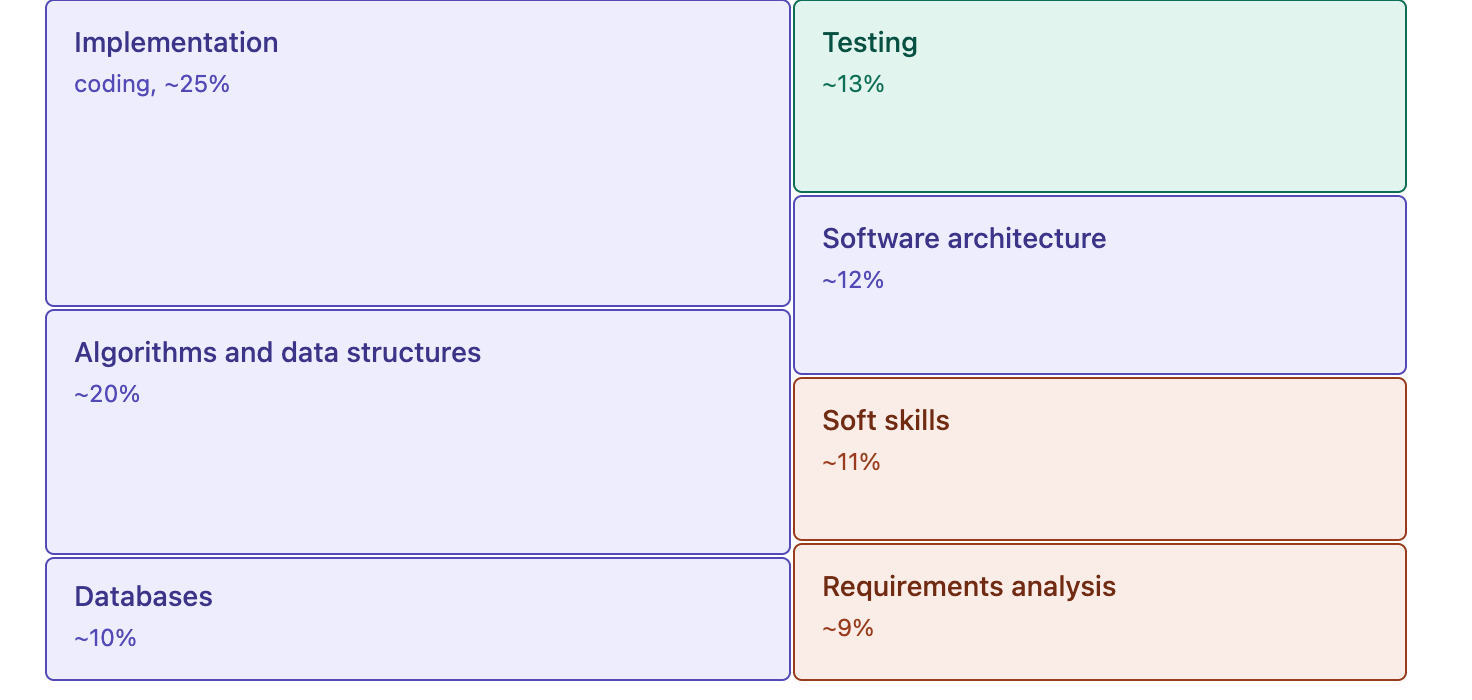 Pre-LLM SWE skill areas, sized by typical time spent, coloured by implementation / QA / collaboration
In today’s agentic coding world, this looks quite different: the boxes that grow are implementation (now largely delegated to AI coding), deployment and infrastructure, maintenance, collaboration, and product judgement. The boxes that shrink are the ones where the tool is now better than the average human: boilerplate, test scaffolding, syntax, even architecture.
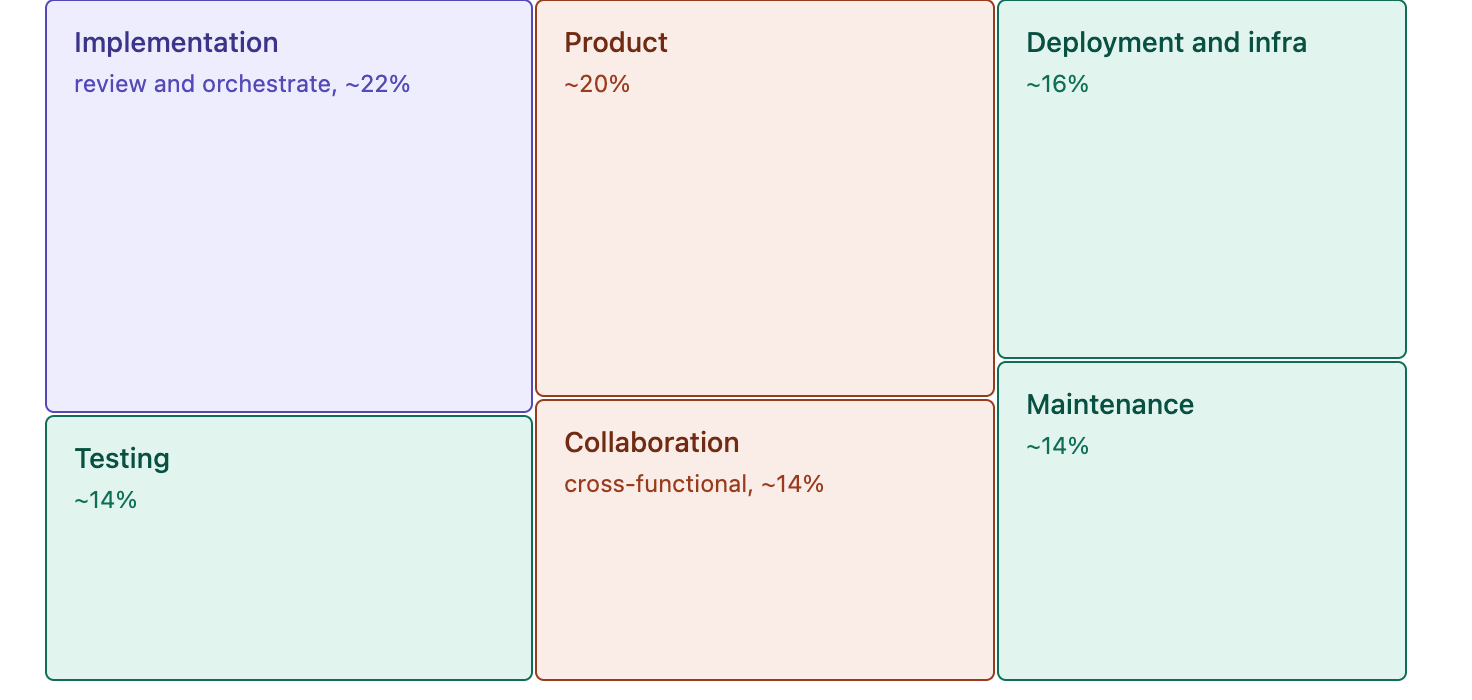 The same treemap, post-agentic coding, showing the shift toward product, ops and collaboration
That second map is not new. It is the product engineer, commonly found in lean startup teams that punched far above their headcount. What was once a relatively rare role is becoming the default job description. And the abstraction keeps climbing: software engineer to product engineer to something we might just call a builder: someone whose unit of work is a shipped business outcome rather than a function.
This was bought, not evolved
The speed of that shift is a function of money. GitHub Copilot crossed 26 million users with 4.7 million paid subscribers and is deployed at about 90% of Fortune 100 companies. Cursor surpassed $4 billion in annual recurring revenue by mid 2026, and Claude Code, launched in May 2025, hit $1 billion in annualized revenue within six months and a $2.5 billion run rate by February 2026. Industry estimates put the AI coding tools market at roughly $12.8 billion in 2026, up from $5.1 billion in 2024. Three multi-billion-dollar revenue lines in one category, in under two years, all aimed at 1.7 million US software developers.
So what happens to everyone else?
If that much capital reshaped engineering that fast, the obvious question is which function is next. Finance is the clearest candidate, and it is already moving, just more slowly. In Gartner’s most recent finance AI survey, 59% of finance leaders report using AI in the finance function, but adoption jumped from 37% in 2023 to 58% in 2024, then barely moved. A separate survey of 258 FP&A leaders found 79% had some adoption of AI tools, but this typically meant automating existing tasks rather than strategic use.
The tooling is arriving in the same three layers we saw in engineering. First, the general chat assistant. Then the plug-in that lives where the work already happens: Excel plug-ins such as Claude for Excel, ChatGPT for Excel and Microsoft Copilot sit between LLMs and purpose-built AI FP&A platforms, bringing the AI directly into the live workbook. Then the agentic platform, with Deloitte’s Q4 2025 CFO Signals survey finding that 54% of CFOs say integrating AI agents into their finance departments will be a top transformation priority in 2026.
Apply the T-shape lens and you can see where each role goes. The FP&A analyst gains capacity on modelling and gains a horizontal reach into data engineering and narrative. The data analyst, who spent years on SQL and cleaning, gains reach into domain interpretation. The financial data analyst, sitting at the seam, might be the finance equivalent of the product engineer: someone who can source, model, interpret and present without waiting on three other teams. My own bet is that the pattern from engineering repeats: analyst to product analyst to, eventually, builder.
Why this is the bigger prize
In the US, software developers held about 1.7 million jobs in 2025. Business and financial operations occupations, the bucket that holds accountants, analysts, compliance officers and planners, reach approximately 10.5 million workers based on May 2025 OEWS totals. That is six times the headcount, before you add the analysts sitting inside management and operations roles. Engineering was the beachhead because engineers could build their own tools and tolerate rough edges. The larger wage bill in most non-tech companies sits on the non-engineering side, and it has barely been touched.
Where I would love other views
Is the “builder” archetype going to permeate across other functions in the org, or does the T eventually snap back into specialisation once the AI tools plateau? Which non-engineering functions move fastest: finance, legal, or operations? Does the pace of role merging match that seen in software engineering? And for those of you in finance or data teams: is the merging of roles something your leadership is planning for, or something that is quietly happening in spreadsheets while nobody looks?