This is a commentary on how early-stage startups should be/are shipping in the age of agentic coding.
Early-stage startups can fail in many ways, but lets focus on product for a moment - startups can fail in mainly two ways: they build the wrong thing quickly, or the right thing too slowly. The canonical advice covers both. Paul Graham says to launch fast because “you haven’t really started working on it till you’ve launched” (Startups in 13 Sentences). Sam Altman is blunter: “I have never, not once, seen a slow-moving founder be really successful” (Startup Playbook). Yet Marc Andreessen’s verdict on why startups fail is about aim, not pace: “they fail because they never get to product/market fit” (The Only Thing That Matters).
So there are two variables. Speed is how fast you ship. Accuracy is how close what you ship is to what a customer needs at this stage, not what they might need in two years. Speed is a scalar and progress is a vector: velocity only counts when it points at the customer.
Complex domains make the trade-off hurt more
In a lot of software, the builder is also the user, so accuracy comes cheap. Graham’s instruction to “live in the future, then build what’s missing” works because the founder already stands where the customer stands (How to Get Startup Ideas). In complex domains such as institutional finance, healthcare, law or industrial operations, that overlap disappears. The knowledge that defines “right” is tacit, held by a small number of practitioners, and rarely written down.
This splits the talent pool. The engineers who ship fastest do not have the domain knowledge, and the domain experts who have it rarely ship at pace. People who do both are scarce, and you cannot plan a company around finding them. Left alone, fast builders produce what YC calls “made-up” or “sitcom” ideas, ones that sound plausible and that nobody needs. Left alone, experts specify the mature product and wait a year for it.
AI coding tools alleviate this trade-off to an extent: as the time and cost of building falls, speed becomes abundant and steering becomes the constraint.
The Pareto frontier
A startup team is Pareto optimal when it cannot ship faster without building less of what the customer needs, and cannot get more accurate without slowing down. Most early teams are nowhere near that line. They sit inside it, fast and off-target or right and late, and could improve on one axis at no cost to the other.
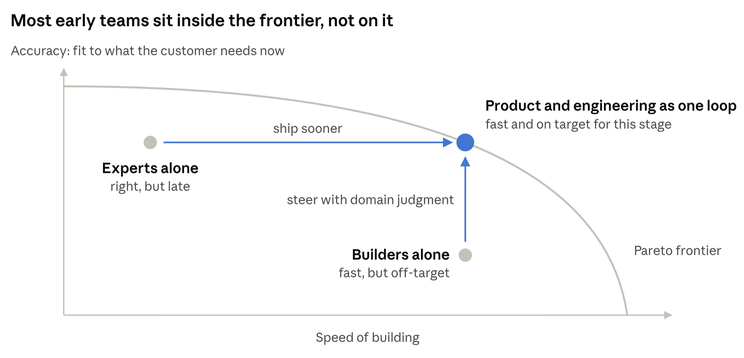 Experts alone reach the frontier by shipping sooner at the same accuracy; builders alone reach it by being steered at the same speed.
Success at this stage is reaching the frontier and then pushing it outward. Where you sit on it is set by stage. Early on, the right point is narrow and deep: Graham’s advice is to satisfy “all the needs of a subset of potential users” and to dig a hole that is “narrow and deep, like a well”. A narrow scope is what makes high accuracy affordable at high speed.
Product and engineering as one loop
What moves a team to the frontier is the latency between domain judgment and code. Altman calls it a “product improvement engine”: talk to users, find what is sub-par, fix it, repeat. “The faster the repeat rate of this cycle, the better the company usually turns out.” In a complex domain that cycle only turns if product and engineering operate as one loop, not as a handoff.
Three things make the loop tight. First, domain judgment steers in real time, not weekly or quarterly: whoever knows what “right” looks like reviews work in progress, not finished features. Second, engineers sit close to the customer. Graham’s version is to “pick a single user and act as if they were consultants building something just for that one user” (Do Things That Don’t Scale). Palantir’s forward deployed engineers are the industrial version, and YC now teaches it to AI founders (The FDE Playbook for AI Startups). Third, each cycle is small enough to be wrong cheaply. Michael Seibel’s rule is to “launch something bad quickly”, then keep the customer and the problem and fix the solution (YC Startup School).
There is a failure mode on this side too. Embedding without feeding the lessons back into product turns a startup into “Accenture for X with a nicer front-end” (a16z). The loop exists to raise accuracy per unit of speed, not to sell bespoke work.
Growth unlocks when what you ship this week is what the customer needs this quarter. Speed gives you shots on goal, accuracy decides whether they are on target, and the product and engineering loop is what lets a team have both.